Home / The guide
Free Blue Valley playbook
The Fairway-Facing Home
A Blue Valley light, heat & privacy playbook
A Blue Valley stand is built to put its best glass against the fairway — which is exactly what makes the Highveld afternoon a problem by mid-year. Here's what the sky over Centurion actually does to a golf-estate floor plan, elevation by elevation, with the trade-offs written down instead of glossed over.
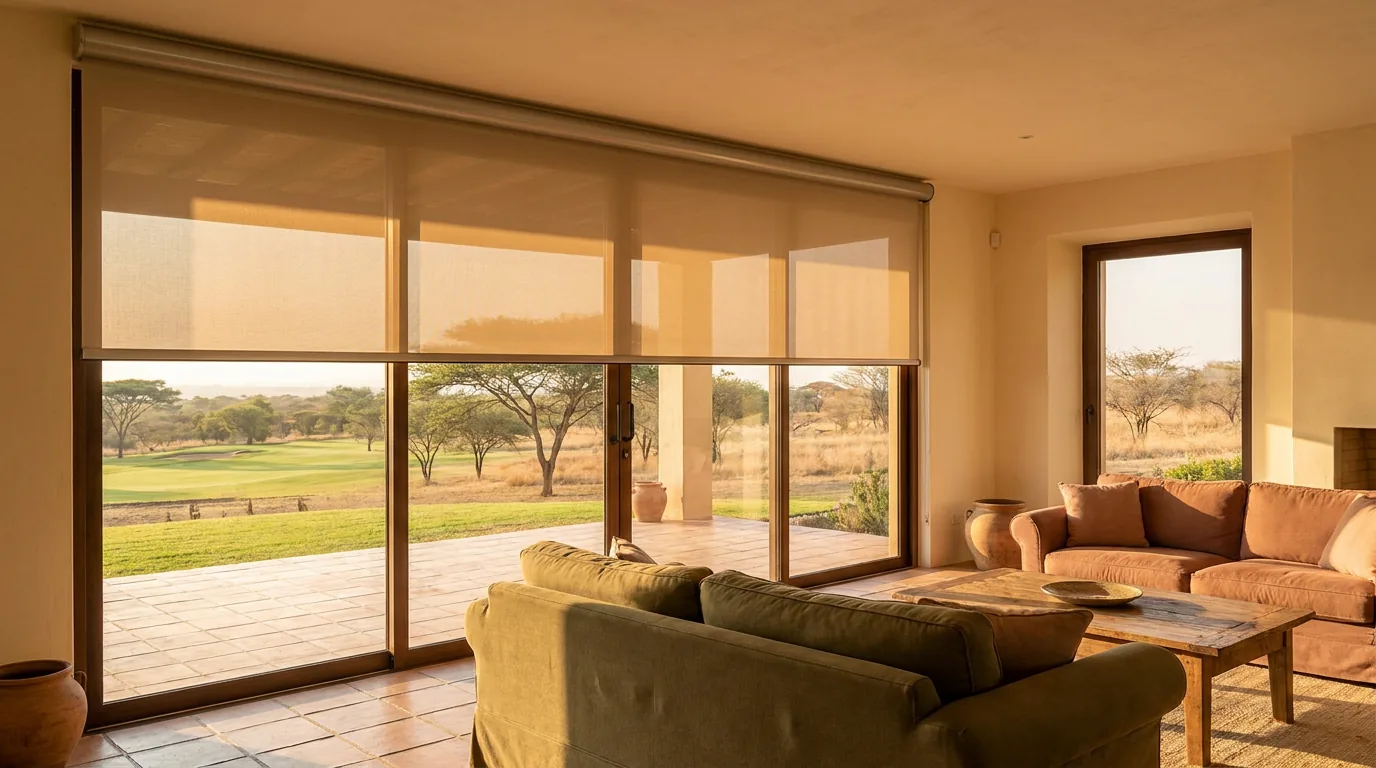 Blue Valley Golf Estate
01 — The brief
Why Blue Valley is its own brief
Most shading advice is written for a flat with one window. Very little of it survives a Blue Valley stand.
Blue Valley Golf & Country Estate spreads over more than 300 hectares of northern Centurion, laid out around a Gary Player signature championship course completed in 2001.[1][3] Something like 1,646 full-title stands sit inside the boom, built to a predominantly Tuscan aesthetic against an "indigenous savannah gardens" landscape theme the estate keeps consistent from stand to stand.[2][3]
That is a different brief to a townhouse or a flat. A golf-estate home is designed to face its best living space at the view — usually a wide, full-height wall of glass onto the fairway, the dam or the savannah planting. The view is the whole reason the stand cost what it did. It is also, almost always, the glass the sun finds hardest.
So the real question here isn't "how do we cover the window." It's how to keep that fairway in view without the room cooking by mid-afternoon — and how to do it in finishes the estate's guidelines will wave through. That's this guide.
02 — The light
What the sun does over the estate
Geometry, not opinion — the published figures that run everything below.
Blue Valley sits at roughly 25.94° S, on the Highveld at about 1,450 m.[7] The nearest published solar-angle study is calculated for Pretoria at 25.733° S — about a fifth of a degree north, close enough that its figures apply here essentially unchanged:[5]
21 December — the sun rises at an azimuth of 116.6°, sets at 243.4°, and at noon stands 87.7° above the horizon, within a few degrees of directly overhead.
20 June — it rises at 64.2°, sets at 295.8°, and climbs no higher than 40.8° all day.
Midday in summer isn't a Blue Valley stand's problem. At 87.7° the sun is near vertical, and an eave, a hedge or the estate's own mature landscaping does most of the work for free. Nobody phones us about noon.
The afternoon is the problem. Sunset swings across a 53° arc of the western sky through the year — 243° in December, 296° in June — arriving almost flat by three or four o'clock, exactly when the house fills up again. No eave, no upstairs balcony, stops a horizontal ray.
Winter light is worth having, not blocking. In June the low midday sun pushes real warmth into a north-facing living room, on days that turn cold by evening — Centurion's July daytime highs sit around 20°C while nights drop to about 5°C, with frost rare but possible on the coldest mornings.[6] Fabric left down all year to beat one bad January throws that free heating away for good.
Altitude adds a fabric question, not just a comfort one: UV rises roughly 10% for every 1,000 m of altitude,[8] and South Africa's Highveld already carries some of the highest UV readings in the world — high even on mild or cloudy days.[9] At ~1,450 m that's real, year-round loading on anything left unprotected on west-facing glass.
03 — Orientation
Elevation by elevation
Find your worst room's wall. On an open-plan estate stand the compass, not the floor plan, decides what a window actually needs.
Sun most of the day — high and short in summer, low and long in winter — and the free warmth that makes a Blue Valley evening bearable once June's cold nights arrive.[6] Blocking it for good over one bad January is the costliest mistake we see on a north-facing living room.
Sunrise swings from 116.6° in December to 64.2° in June,[5] so an east bedroom takes a hard, low hit at first light and almost nothing after mid-morning — a smaller heat load than the west's. A main bedroom or nursery on this wall wakes the house before the alarm does.
Low sun across that 53° arc for the whole back half of the day, through the hottest hours a Highveld summer has. An unscreened slider onto the fairway here turns the open-plan living area into a greenhouse by mid-afternoon. Where you stop the sun matters as much as what you stop it with.
Almost no direct sun all year, and the coldest rooms come June.[5] On a stand with limited boundary planting it's also the wall most likely to sit open to the fairway or a neighbour. Shading is rarely the brief here — being overlooked, or the room simply being cold, is.
Optional
Want this marked up for your own home?
Tell us which rooms are the problem and we'll send this playbook back with your own elevations noted against it — which windows we'd treat first, and what we'd weigh up on each.
It's an email, not a visit. Nobody phones you about it.
04 — The specification
What we'd fit here, and the catch with each
Each is right somewhere on a Blue Valley stand and wrong somewhere else. Tap "add to my enquiry" on anything that sounds like your room — it carries straight into the form below, no retyping.
Open-plan living & dining, west and north
Sunscreen roller blinds
One smooth flat sheet of open-weave fabric on a tube. The weave keeps the fairway readable through the blind while cutting glare, heat and a good share of that Highveld UV[9] off the furniture behind the glass.
Why not a blockout here: a blockout stops more heat but also the view, so it lives permanently down and you lose the reason you bought the stand. The catch: an open weave still lets low afternoon sun through — on the worst west rooms it's the second layer, not the whole answer.
Bedrooms, especially east-facing, on the view
Double roller (day & night)
Two flat fabrics on one bracket — a sheer sunscreen and a solid blockout — so a view-facing bedroom dials from "fairway in full view" to "properly dark" without swapping blinds. The sunscreen keeps the outlook by day; the blockout buys back the sleep a Highveld sunrise steals from an east room.
Why not just a blockout roller: a single blockout is either up or down — you lose the view to get the dark. The catch: a reveal-fit blind leaves a hairline gap either side; true edge-to-edge dark for a nursery or a shift worker wants an outside fit or side channels — a measuring decision, not a fabric one.
The worst west & north-west glass
External venetians
Adjustable metal slats mounted outside the glass. Because they stop the sun before it reaches the pane, they keep a west room cooler than any interior blind can — and being tiltable, they cut the heat without going fully dark, so you can still read the fairway through angled slats.
Why outside beats an interior blind: anything inside the glass still lets the warmed pane radiate heat into the room; stopping the sun outside means that heat never gets in. The catch: it's an exterior change the estate will want to sign off, and it's a bigger spend than an interior roller — worth it on the rooms that genuinely bake, harder to justify on the ones that don't.
West sliders, where the guidelines allow
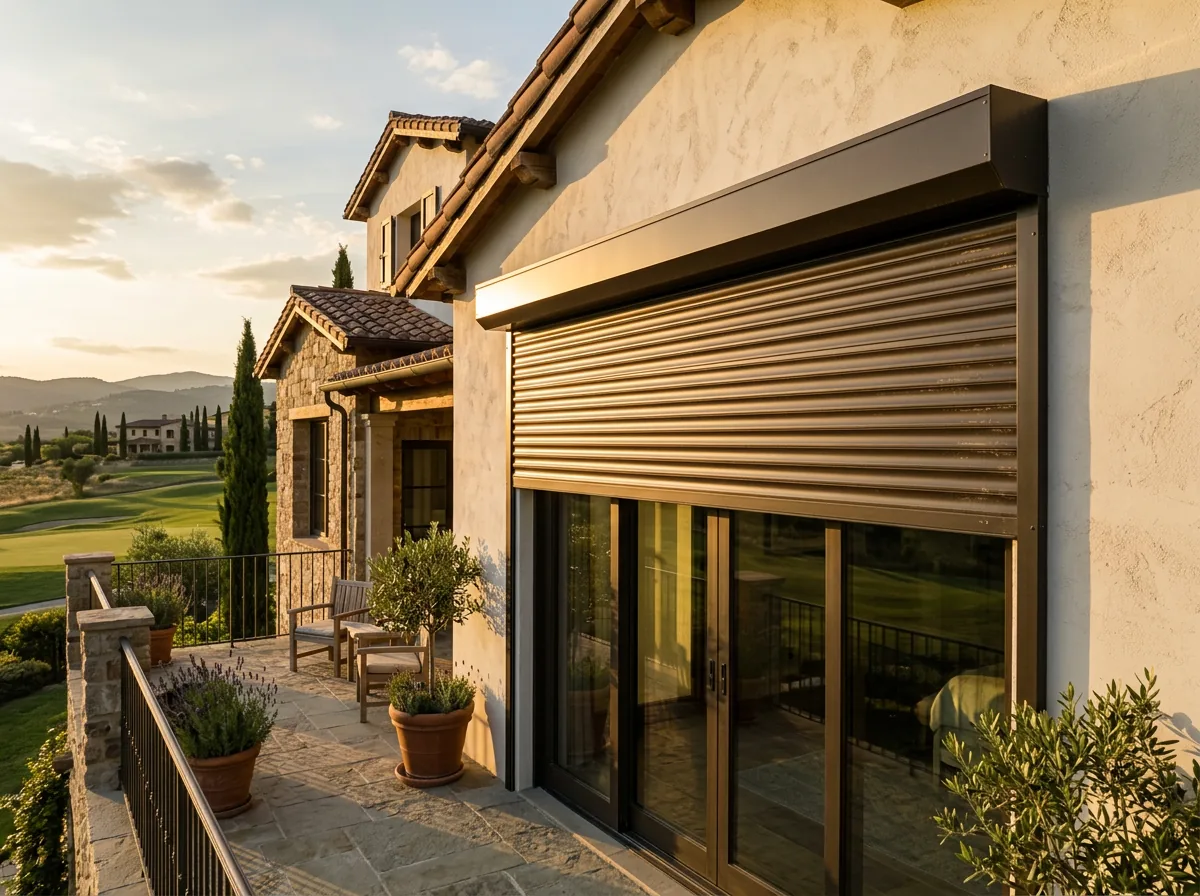
Roller shutters
Rigid aluminium slats roll down from a headbox on the outside of the glass — the single strongest move on a west elevation, because the sun never warms the pane in the first place. They can be specified in a bronze, white or grey powder-coat, which is exactly the hardware palette the estate already permits.[4] To be plain: these are shading shutters, sized for sun, heat and glare — not security-rated shutters, which are a different product we can quote separately.
Why not an interior blockout: same reason as the external venetian — outside stops the heat, inside only manages it once it's arrived. The catch: it changes what's visible from the street or fairway, so on a Tuscan estate this is a guidelines conversation before it's an order — one we'll help you put in writing.
Double-volume rooms & anywhere that gets cold
Cellular / honeycomb blinds
Rows of hexagonal cells trap a layer of still air against the glass, so they insulate rather than just filter — real relief in a double-volume Tuscan living room that bakes by four in summer and hands its heat straight back out on a frosty June morning.[6]
Why not a plain roller for the same window: the air layer works both ways — heat out in summer, warmth held in through a cold Highveld night — where one fabric sheet only ever does one job at a time. The catch: it costs more than a plain roller for the same opening, and a top-down/bottom-up version adds a little more again.
Kitchen, scullery & bathrooms
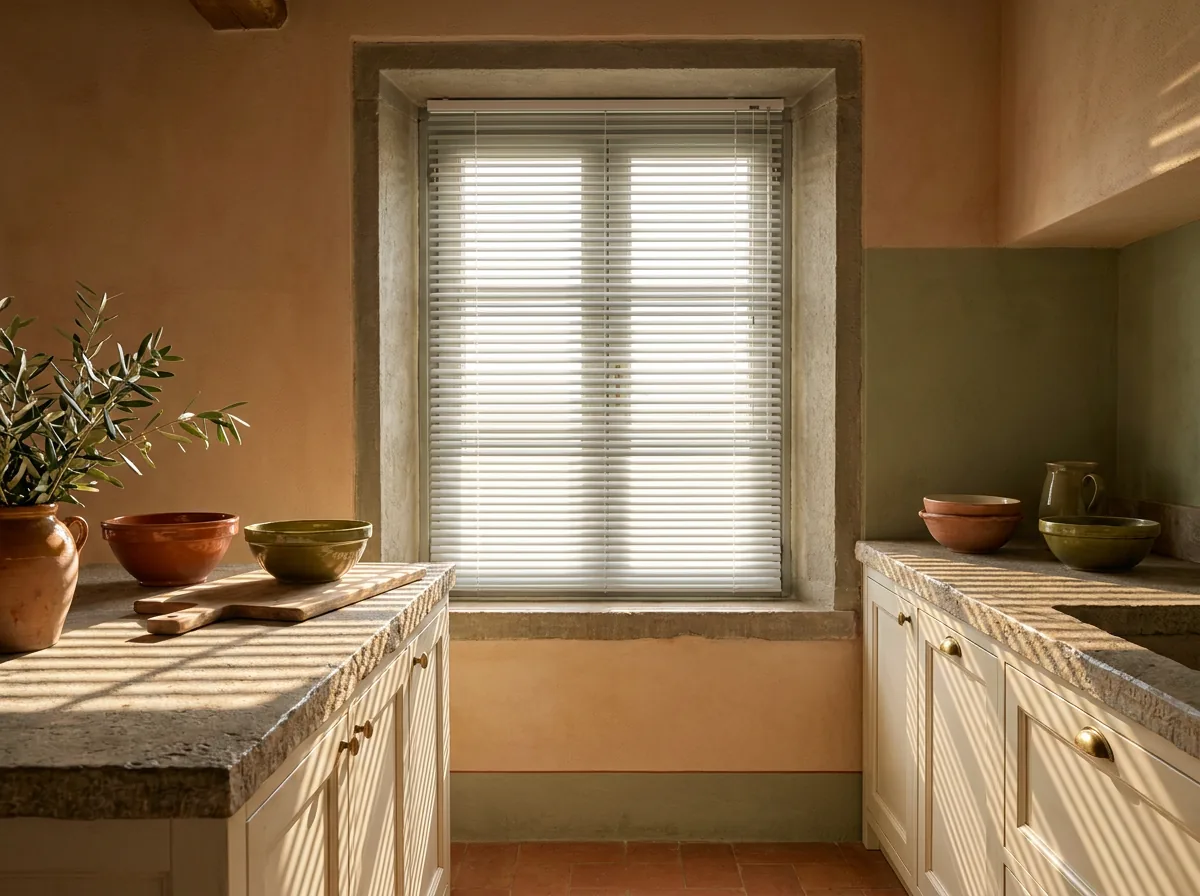
Aluminium venetian blinds
Thin, tiltable metal slats — wipe-clean and heat-tolerant where fabric struggles with steam and cooking. Tilt them and low afternoon sun throws onto the ceiling instead of the countertop, so the glare goes without losing the daylight.
Why not a roller here: fabric holds odour and grease in a working kitchen; aluminium doesn't, and it shrugs off irrigation overspray and Highveld dust. The catch: a lot of slats means real dusting, and on a wide kitchen window the stacked headrail is deep enough to notice.
Covered patio & braai area
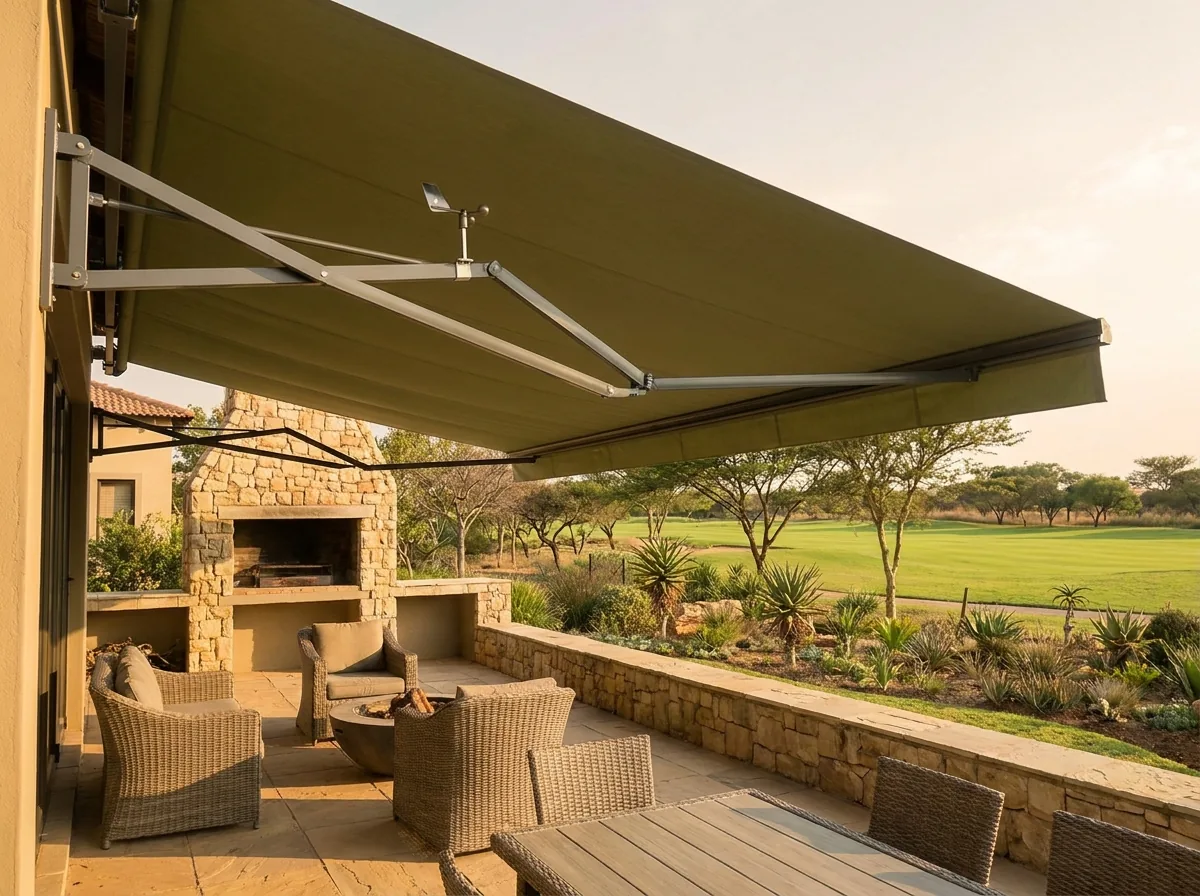
Folding-arm awnings
Hinged arms extend the fabric over the patio with no poles in the way of the furniture, and retract fully to let winter sun back onto the same spot — exactly what a Blue Valley outdoor entertaining area is built for.
Why not a fixed roof: it blocks the low winter sun you'll want back in June, and needs its own sign-off. The catch: Gauteng hail runs from about mid-November through February and peaks in the afternoon[10] — braai time — so an automatic wind sensor that retracts the awning before the gust arrives isn't optional here, it's the reason the awning survives its first summer.
Wide sliders, out-of-reach glass & anything on a timer
Motorisation & automation
Battery motors are the retrofit default — no chasing cable through a rendered wall. Group the west-facing blinds and set them to close on a timer or a sun sensor before the afternoon heat lands, so the room is already cool when everyone gets home; a wind sensor does the same job for the awning.
Why battery over wired: no electrician and no channel cut into a Tuscan wall you'd need signed off. The catch: batteries want recharging every few months — how often depends on the blind's size and how hard it works, a measure-day judgement rather than a brochure guess.

Also in the range
Six more, briefly
Blockout roller blinds
A single flat sheet in a light-stopping fabric — the simplest full-dark answer for a media room, a guest room or any window where the view isn't the point.
Timber venetian blinds
Warm wood-grain slats for a study or formal room that suits the estate's Tuscan joinery — aluminium's precise tilt with more warmth, heavier, so wide openings split in two.
Vertical & panel blinds
Vanes or wide fabric panels stack clear to one side, so a wide slider onto the veranda stays fully usable instead of sitting behind fabric bunched at one end.
Concealed / recessed blinds
Built into a ceiling slot or pelmet so the blind drops with no visible headbox — the clean finish for double-volume glazing, easiest specified while a build or renovation is still open.
Skylight & shaped blinds
Gables, apex glazing and stairwell skylights — the awkward openings that need a made-to-template fit, almost always tensioned or motorised above reach.
Blind repairs & re-cording
A snapped cord, a tilt that stopped tilting, a blind hanging skew since the last repaint — most of it is a repair, and we'll say so honestly rather than quote you a new unit.
05 — The rules
The estate's Tuscan guidelines, and how to work with them
Blue Valley's architecture is held to a predominantly Tuscan aesthetic with compulsory Tuscan elements,[2] and the design guidelines reach as far as your windows: only timber or aluminium windows are permitted, aluminium in bronze, natural anodized, white or grey powder-coat, with timber shutters and decks encouraged.[4]
That's useful to know rather than something to fear. It means exterior shading hardware — a roller shutter headbox, an external venetian, an awning cassette — can be specified in exactly the bronze, white or grey the estate already accepts on your window frames, so it reads as part of the house instead of an add-on. Anything visible from the street or the fairway is worth clearing with the HOA before you order, not after, and we'll put the finish and profile in writing so the submission is easy.
An internal blind, inside your own reveal, changes nothing anyone outside can see — and is generally nobody's business but yours.
We could not find Blue Valley's own line-by-line rule for aftermarket blinds and shading online, so if your trustees or managing agent hold a documented colour or fixing requirement, tell us at the measure and we'll work to it from day one.
And if you're renovating rather than just dressing existing windows: SANS 10400-XA:2021 raised the glazing-to-floor-area threshold that triggers an energy calculation from 15% to 20%, and dropped the old rule that judged west-facing glass more harshly than north or east.[11] Opening up a Tuscan floor plan with more glass than the original plan had is worth checking against the current 20% figure, not an older one.
06 — The honest limits
What we'd still need to check on site
All of that is true of Blue Valley. None of it is true of your stand until somebody stands in it — five things no guide can settle:
The actual reveal depth
Timber and aluminium window frames take different fittings, and even within one house the reveal can vary opening to opening. That single measurement decides inside-or-outside fit — which decides whether a bedroom actually goes dark.
What we're allowed to fix into
A rendered Tuscan wall, a plasterboard bulkhead, a structural lintel: each takes a different bracket, and an exterior fixing may need the estate's sign-off first. We check before you order, not on fitting day.
Your stand's real wind exposure
A stand sitting open to the fairway or a water feature catches weather a sheltered inner stand never sees. Gauteng's hail pattern is published;[10] your patio's orientation and exposure are not, and they decide whether a wind sensor is a nice-to-have or non-negotiable.
What glass you already have
Blue Valley is still building out, so stands span the estate's early years and recent rebuilds, sometimes on the same street — different eras of glazing.[11] Only the actual pane tells us what shading is doing real work here versus just habit.
Power routing and the charging reality
Whether a plug is reachable for a motor's charger, whether a solar charger would ever see sun on that elevation, whether an existing point can be reused — on a double-volume stairwell blind that decides whether motorisation is a pleasure or a chore.
07 — Two ways forward
Book the free expert measure
A consultant comes to the house with fabric and slat samples, takes the compass reading rather than guessing it, measures every window and leaves a written quote per window. It costs nothing and commits you to nothing. Would rather have a rough number first? The ballpark list sits inside the form below — quieter, and entirely optional.
Our consultant does five or six measures a week across Blue Valley and the neighbouring Centurion estates, so the diary fills early — worth booking ahead if you need a particular day.
Anything you added while reading is already carried into the form. You don't have to type it again.
Neither, for now
Just take the playbook, marked up
Not ready for a visit or a number? Tell us which rooms are the problem and we'll email you this playbook with your own elevations noted against it. Nothing is booked, nobody phones.
Working out
Sources
Every climate, geography, solar and estate-rule claim above traces to one of these. Where we've reasoned rather than cited, we've said so in the text.
- Centurion Property — Blue Valley Golf & Country Estate: Gary Player signature 18-hole course completed 2001; estate over 300 hectares between northern Johannesburg and Pretoria, near the N1 Samrand interchange. centurionproperty.co.za — Blue Valley Golf Estate
- Seeff Property Group — Blue Valley Golf Estate area profile: "indigenous savannah gardens" theme with a predominantly Tuscan building aesthetic and compulsory Tuscan elements in the home-building guidelines. seeff.com — Blue Valley area profile
- Estate Living — Blue Valley Golf Course: estate over 300 hectares, 1,646 full-title erven, Gary Player designed course. estate-living.co.za — Blue Valley Golf Course
- Blue Valley Residential Design Guidelines (June 2019): windows permitted in timber or aluminium only, aluminium in bronze, natural anodized, white or grey powder-coat; timber shutters and decks encouraged. bluevalleyestate.co.za — Residential Design Guidelines (PDF)
- "Sun, shade and natural daylight in South African town planning, with emphasis on Pretoria," Acta Structilia — Pretoria at 25.733°S; 21 December sunrise azimuth 116.62°, sunset 243.35°, solar-noon elevation 87.7°; 20 June sunrise 64.24°, sunset 295.76°, solar-noon elevation 40.84°; and the observation of how much hotter western afternoons are than mornings. scielo.org.za — Sun, shade and natural daylight
- climate-data.org — Centurion: January average high ~28°C; July daytime highs ~20°C with nights near 5°C; frost rare; annual rainfall ~661 mm, summer-dominant with December the wettest month (~118 mm). climate-data.org — Centurion
- Topographic reference — Centurion elevation roughly 1,450 m on the Highveld (the interior plateau generally above ~1,500 m). topographic-map.com — Centurion; Wikipedia — Highveld
- World Health Organization — "UV levels increase by approximately 10% with every 1000 metres in altitude." who.int — Radiation: Ultraviolet (UV) Q&A
- Koolasun — South Africa UV Index: the Highveld sits at ~1,200–1,800 m where UV intensity rises ~10% per 1,000 m, and South Africa records some of the world's highest UV, high even on mild or cloudy days. koolasun.co.za — SA UV Index
- Punge et al., "Characteristics of hail hazard in South Africa based on satellite detection of convective storms," Nat. Hazards Earth Syst. Sci. 23, 1549–1576 (2023) — Gauteng/Highveld hail most frequent from about mid-November through February, peaking in the afternoon (≈13:00–17:00). nhess.copernicus.org — Hail hazard in South Africa
- Roos Architects — Summary of the revised SANS 10400-XA standard (2021 edition): the fenestration-calculation threshold rose from a 15% to a 20% glazing-to-floor-area ratio, and the edition draws no distinction between the SHGC requirements of west-, north- or east-facing glazing. roosarchitects.co.za — Summary of the revised SANS 10400-XA
Four honest caveats. The solar figures in source 5 are calculated for Pretoria at 25.733° south; Blue Valley sits at roughly 25.94° south, so its own angles differ by about a fifth of a degree — we quote the published numbers rather than invent our own. Temperature, rainfall, frost and hail detail is Centurion- or Gauteng-wide, because there is no published Blue Valley Estate weather station. Elevation is given as "roughly 1,450 m" because published figures for Centurion vary a little by method and exact point. And Blue Valley's own internal rule for aftermarket blinds, awnings and roller shutters was not found published online — this guide describes only the general, sourced Tuscan window and finish guidelines, and says plainly that homeowners should confirm specifics with their own HOA or managing agent.